The idea of islands
as laboratories where natural selection expresses its stranger side is not
difficult to justify. Many species on islands are unique, and uniquely
different from their mainland counter-parts. Dwarf elephants, giant carnivorous
birds, the world’s largest stick insect (and largest insect to boot) – all of
these are (or were) the inhabitants of islands. The biotas of islands often
consist of multiple
endemic species , and whilst the term island conjures up images of tropical
paradise, for biological purposes an island can be taken to mean anything from
an isolated mountain-top, to a patch of forest in otherwise monotonous
grassland.
 |
Figure 1: Elephant bird (Aepyornis maximus)
|
The capability of mainland species’ to reach
islands is of importance in how well the biotas in these restricted areas end
up reflecting the composition of mainland biotas. As such, two broad divisions can be made:
harmonic and disharmonic biotas. Harmonic biotas are those in which the
assemblages of organisms present are similar to that found on the mainland in
that whilst fewer species occur, proportionately the ecological groupings or
taxa are the same. Disharmonic biotas result due to a difference in dispersal ability
of organisms, as well as factors such as competition. Essentially, those organisms
which are better at reaching islands (such as flying animals or wind-borne
seeds) may be disproportionately represented. Other taxa from the mainland may
never make it to the island at all, and, naturally the more isolated the island
the fewer species are expected to occur there. The larger an island’s size, the
more species may reasonably be expected to survive there. These are all common
sense rules of island
biogeography .
Once a population becomes
established in its new island home, the different selective pressures it faces
may result in some very strange changes in evolutionary development. Some of
these evolutionary trends are common to island organisms. Reduced dispersal
ability is one such development. Now it may seem counter-intuitive that
organisms on islands should lack the ability to leave, but loss of long
distance mobility has advantages. In insects, specimens which restrict their
movements to a home range area are more likely to avoid death at sea on an
oceanic island, thus they will survive and breed. Flightless birds sacrifice
mobility for lower energy investment. They no longer have to grow strong flight
muscles, as predators are often missing from island areas. Coupled with the
fact that resources may be scarce, it makes sense to avoid unnecessary
commitment of energy to flight.
Flightlessness can also be rooted
in another island phenomenon: Gigantism. On islands, organisms may have the
opportunity to evolve to much larger sizes. The island of Madagascar for
example once housed Elephant birds - 400 kilograms and three terrifying meters
tall. The development of such an imposing physique may be related to ecological
release (the concept that in the absence of competition, a species may
develop in a way that allows broader habitat and niche use). Competition between
members of the same species becomes more important than competing with other
species, and therefore being larger may mean access to better territory and
food resources. Many examples of gigantism on islands exist. On the island of
Minorca, around 3 million years ago, a massive rabbit relative Nuralagus rex outstripped its mainland
relatives in size by twelve times. Along with a Minorcan giant tortoise, this
lumbering rabbit dominated the landscape in the absence of predators or
competitors.
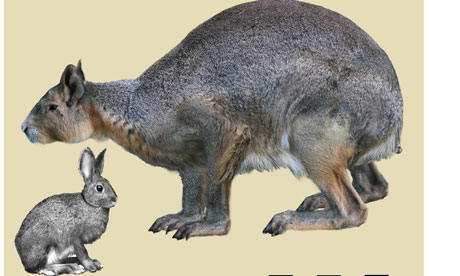 |
Figure 2: Nurolagus
rex as compared to modern rabbit
|
Naturally, however, a different
rule must apply to large animals reaching islands. Well, actually, it’s the
same rule, the so called ‘island rule’ which states larger species will evolve
to become smaller on islands and smaller species will develop to become larger.
Dwarfism is also prevalent on islands, and if we return to the example of
Madagascar where the world’s largest bird became extinct, we find an entire
genus of dwarf chameleons still wandering the leaf litter of the forest floors.
Dwarfism may result from limited resource availability or dwarf organisms may
simply be better adapted to obtain nutrients and efficiently utilise them than
their larger counterparts.
 |
Figure 3: Crotalus
ruber
|
A fascinating example of how
resources and the pattern of colonisation can affect species size can be found
on the island of Angel de la Guarda in the Gulf of California. Two species of
rattlesnakes occur on the mainland near the island, the large species Crotalus ruber and its half-sized
relative Crotalus mitchelli. On the
island itself however, Crotalus ruber
specimens are half the size of C.
mitchelli, an exact reversal. The reason for this is thought to be that C. mitchelli dispersed to the island
first where it became larger than its mainland counterpart, due to lack of
competitors. When C. ruber
arrived, the ‘large snake’ niche was already taken, thus limited resources
caused a trend towards smaller specimens, until ultimately the snakes on the
island filled the same niches as their mainland relatives, simply in reversed
order.
The existence of species in
isolated patches such as islands allows scientists a unique opportunity to
study evolution and evolutionary processes on a manageable scale. It’s no
co-incidence that both Darwin and Wallace came to their revolutionary ideas by
studying island fauna. Islands exaggerate evolutionary processes in a way that
allows for deeper understanding of the workings of processes like Natural
Selection in a contained, natural laboratory.
Works Cited:
BROWN, J.H. & LOMOLINO, M.V. 1998. Biogeography. 2nd Edition. Sinauer Associates Inc.,
Massachussets.
KAY, A.E. 1994. A Natural History of the Hawaiian Islands: Selected Readings II. University
of Hawaii Press, Honolulu.
QUINTANA, J., KOHLER, M. & MOYA-SOLA, S. 2011. Journal
of Vertebrate Paleontology 31(2):231-240. Available
online at: http://www.bioone.org/doi/abs/10.1080/02724634.2011.550367
(Accessed 01/03/2013).
TYSON, P. 2008. Gigantism and Dwarfism on Islands. http://www.pbs.org/wgbh/nova/evolution/gigantism-and-dwarfism-islands.html
(Accessed 01/03/2013).

No comments:
Post a Comment