Friday, 26 April 2013

Humanity’s shadow: The spread of man across the Earth


It all started with a woman. Or at least, we can trace it back to one. The origin of the species Homo sapiens, a likely descendant of Homo erectus can be linked to the DNA of a single female specimen scientists called ‘Eve.’

Now before everyone starts preparing for the rapture we must be clear that Eve was not our earliest ancestor, nor was she the first woman. Rather, she was an early modern human from a time when modern humans were rather rare. The important thing to note is: Eve, and everyone else at that time, originated in Africa.

Figure 1: Homo erectus
Figure 2: Homo sapiens
The date for the advent of Homo sapiens is around 200 000 years ago. Prior to this, Homo erectus, the first hominid to tame fire, is thought to have migrated from Africa to Arabia, Asia and Europe some 800 000 years ago. Homo sapiens soon outstripped its predecessor however, moving out of Africa around 125 000 years ago. Between 85000-75000 years ago, humans spread from Arabia to India, Borneo and South China, hugging the coast all the while. By 60 000 years ago, Australia was no longer virgin territory, humans having crossed there from South-east Asia. Finally, a changing climate 50 000 years ago was the catalyst which allowed humans to migrate up into Europe. Central and North-east Asia were next for our intrepid ancestors, and the colonisation of Siberia around 40 000 years ago preceded expansion into the Americas.
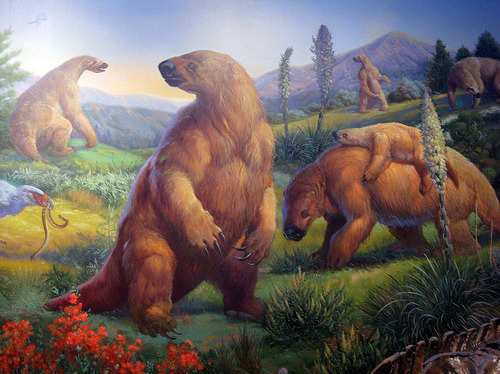

The colonisation of the New World was remarkable in that the spread of humans was so rapid. Indeed, we could say it was plague-y. Human predation is listed as a primary reason for the disappearance of 35 genera of large mammals including ground sloths, giant tapirs, large predators and mammoths. Plague or not, humanity managed to expand over the course of only 10 000 years from North America down into South America. There is evidence that the expansion to the Americas may even have involved watercraft, with humans expanding along the coast then into the interior of these continents. Regardless of how it was achieved, by 12500 years ago, our distribution was almost global. An excellent interactive map of this human migration is available here.
Figure 3: The now extinct Giant Ground Sloth

In a relatively short time (in evolutionary terms), humans learnt to co-operate, to live in communities, communicate ideas and even to sail. We colonised islands and icy places, increasingly using our technology and great ingenuity to shape the world to our own ideal.


References

BROWN, J.H. & LOMOLINO, M.V.1998. Biogeography. 2nd Edition. Sinauer Associates Inc., Massachusetts.

GUGLIOTTA, G. 2008. The Great Human Migration. http://www.smithsonianmag.com/history-archaeology/human-migration.html?c=y&page=5 (Accessed 25/04/2013).

GRAYSON, D.K. 2001. The Archaeological Record of Human Impacts on Animal Populations. Journal of World Prehistory 15(1): 1-68.

Friday, 12 April 2013

The ravages of ice: How glaciation affects biotas


Imagine a sheet of ice creeping inexorably across the landscape over millions of years, moving downwards from the poles. Regions once mild in climate become part of an ever expanding frozen wasteland. This terrible, slow process of advancing ice is called glaciation. In the past, glaciation events have shaped our planet. Individual glaciers can carve through rock and flatten landscapes. The raw power of ice has shaped the very nature of life on Earth.

The general cause of glaciation events is a change in Earth’s mean temperature and an increase in snowfall at higher latitudes. The underlying causes of such temperature shifts however vary. Factors which can cause the Earth’s mean temperature to drop by a few degrees Celsius include a large-scale increase in volcanism and meteor collisions. In both scenarios, less solar energy reaches Earth’s surface due to more dust in the atmosphere, and the temperature drops as a result. Glaciation is not a randomly occurring process however and the commonly accepted  theory to explain patterns of glaciation is that of Milankovitch cycles.  Milankovitch was a Serbian scientist who observed that not only does the angle of Earth's tilt change, but that our planet 'wobbles' on its axis. He also noted that the Earth's distance from the Sun varies as the orbital path our planet follows changes in shape. The force behind the global temperature changes during glaciation is thus once more a change in how solar radiation reaches Earth. As a result of such fluctuations, climatic conditions on Earth are dissimilar during glacial and inter-glacial periods.

Figure 1: Variations in Earth's orbit associated with periods of glaciation.

Naturally, such changes affect Earth’s biota. Regions once suitable for particular species become less so and the range of species may contract or the species may suffer extinction. Other species may have the opportunity to expand their ranges. Species ranges may also simply shift in latitudinal terms. Entire biomes may move polewards or towards the equator. Another possibility is that a species will be able to adapt to the new conditions within its current distribution. The nature of the response by individual species depends on the characteristics of those species. In order to survive a period of glaciation, a species must both adapt to changes in its physical circumstance such as altered conditions of climate and geography and be intrinsically suited for the new world in which it finds itself or able to disperse to a suitable area.  Over time, natural selection may result in a change in the morphology of a species. Bigger individuals for example may better survive an icy world due to their superior heat retention and these genes may be passed along preferentially.


Besides changing the distribution of species, glaciation may cause entirely new species to form. One of the driving forces of speciation is geographic isolation. When a glaciation event occurs, species may retreat to refugia – isolated pockets of suitable habitat – and within these, entirely new species may form over tens of thousands to millions of years. When the ice retreats, these species can once more spread, expanding their ranges into new suitable territory.

Figure 2: Species may escape unfavourable climatic conditions by retreating into refugia

Due to the extinction of some species and the adaptation or formation of others, periods of glaciation change the structure of communities and eventually the biotas of entire regions. Further changes take place when the ice recedes. New species spreading into new territory may compete as they expand their ranges and further extinctions may occur. Though some communities may survive unchanged during glaciation, entirely novel ones will also form. Thus as the tide of ice expands and retracts over geological time, it leaves in its wake a changed world.

Works Cited:

BROWN, J.H. & LOMOLINO, M.V. 1998. Biogeography. 2nd Edition. Sinauer Associates Inc., Massachussets.

PARMESAN, C., ROOT, T.L. & WILLIG, M.R. 2000. Impacts of Extreme Weather and Climate on Terrestrial Biotas. Bulletin of the American Meteorological Society 81(3): 443-449. Available online at: http://journals.ametsoc.org/doi/pdf/10.1175/1520-0477(2000)081%3C0443%3AIOEWAC%3E2.3.CO%3B2 (Accessed 11/04/2013).

RAND, A.L. 1948. Glaciation, an Isolating Factor in Speciation. Evolution 2(4): 314-321. Available online at: http://www.jstor.org/stable/2405522 (Accessed 11/04/2013).

RITTER, M. E. The Physical Environment: An Introduction to Physical Geography. 2006. Available online at: http://www.uwsp.edu/geo/faculty/ritter/geog101/textbook/title_page.html
(Accessed 11/04/2013).

SCHIEBER, J. Milankovitch Cycles and Glaciation.  http://www.indiana.edu/~geol105/images/gaia_chapter_4/milankovitch.htm 
(Accessed 12/04/2013).