 Humanity’s shadow: The spread
of man across the Earth
Humanity’s shadow: The spread
of man across the Earth

It all started with a woman. Or
at least, we can trace it back to one. The origin of the species Homo sapiens, a likely descendant of Homo erectus can be linked to the DNA of
a single female specimen scientists called ‘Eve.’
Now before everyone starts
preparing for the rapture we must be clear that Eve was not our earliest
ancestor, nor was she the first woman. Rather, she was an early modern human
from a time when modern humans were rather rare. The important thing to note
is: Eve, and everyone else at that time, originated in Africa.
 |
| Figure 1: Homo erectus |
 |
| Figure 2: Homo sapiens |
The date for the advent of Homo sapiens is around 200 000
years ago. Prior to this, Homo erectus, the first hominid to tame
fire, is thought to have migrated from Africa to Arabia, Asia and Europe some
800 000 years ago. Homo sapiens
soon outstripped its predecessor however, moving out of Africa around
125 000 years ago. Between 85000-75000 years ago, humans spread from
Arabia to India, Borneo and South China, hugging the coast all the while. By
60 000 years ago, Australia was no longer virgin territory, humans having
crossed there from South-east Asia. Finally, a changing climate 50 000
years ago was the catalyst which allowed humans to migrate up into Europe.
Central and North-east Asia were next for our intrepid ancestors, and the
colonisation of Siberia around 40 000 years ago preceded expansion into
the Americas.
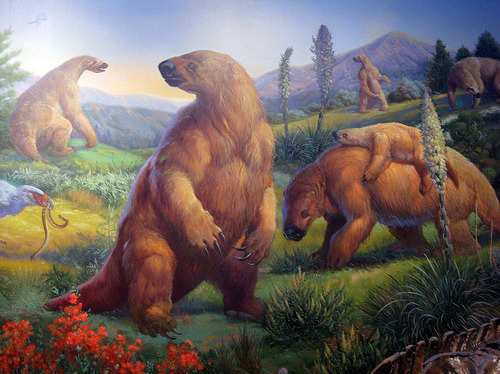 |
| Figure 3: The now extinct Giant Ground Sloth |
In a relatively short time (in
evolutionary terms), humans learnt to co-operate, to live in communities,
communicate ideas and even to sail. We colonised islands and icy places,
increasingly using our technology and great ingenuity to shape the world to our
own ideal.
References
BROWN, J.H. & LOMOLINO, M.V.1998. Biogeography. 2nd Edition. Sinauer Associates Inc.,
Massachusetts.
GUGLIOTTA, G. 2008. The Great Human Migration. http://www.smithsonianmag.com/history-archaeology/human-migration.html?c=y&page=5
(Accessed 25/04/2013).
GRAYSON, D.K. 2001. The Archaeological Record of Human
Impacts on Animal Populations. Journal of World Prehistory 15(1): 1-68.

No comments:
Post a Comment